 Hal Whitehead and Luke Rendell
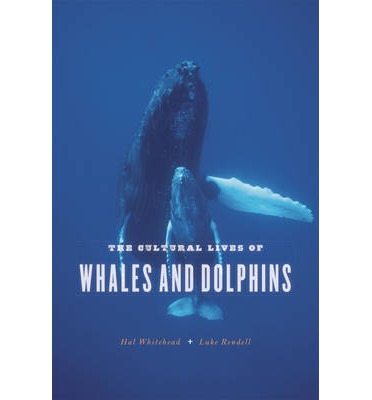
I got this book for Christmas from Anna and it was my equal best present – equal to a pair of lovely reading glasses from Ted and Gill that I’m scared to wear in case I lose them. It’s a beautiful hardback with an ocean blue cover, featuring a humpback whale calf, vertically nestled by its mother under her huge flipper.
Humpbacks are baleen whales with distinctively large flippers. They have a behaviour called breaching in which they surface at full speed, then crash back into sea with a bang. Is it to look around? To cool the blood? To impress the females? Or just playing? There are different theories. Anyway I saw humpbacks when I went on a whale-watch at Cape Cod in 1985, and it was brilliant. I was with David Rubin and some other members of the New York Greenpeace crew: Bryan Bence, Scott Pinet, Mark Beta, Billy Comfort, Sweet Lori and Paul Stewart the Welshman. We’d spent an afternoon canvassing and next day, in cool, damp weather, went on a whale watch. It was the best of times.
When I’m playing the if only game, I wonder if I might have carried on at Greenpeace for a few years, roaming the prairies of America – instead of rushing back to Sea World Britain and a lifetime of captivity.
Humpbacks are famous for their songs too. This became a big thing in the 1970s, when somebody released a recording of humpbacks. Then people heard their haunting melodies for the first time. It was a cultural episode, almost a B-side to the first moon landing, and suddenly people saw whales in a different way. This coincided with the start of the anti-whaling movement – for which Greenpeace became famous.
Humpback songs are the most elaborate and lengthy of all whale songs, with cycles lasting for hours, and perfectly reproduced each time. The songs seem to be to do with mating – because it’s only the males who sing. Other whales also sing (some with clicks), but not with the range of humpback sounds and harmonies.
According to Whitehead and Rendell, the oceans are noisy places – due to the singing of whales. They would have been noisier before whale populations were so reduced by humans. The abilities to vocalise and hear well are mammalian adaptations that the ancestors of whales developed further when they went to sea. Underwater, light doesn’t get far – so it’s hard to see – but sound travels faster than in air. Whales use this. Their vocalisations can carry hundreds of miles.
In their evolution, whales developed systems of echolocation that enable them to have a very precise three-dimensional picture of their surroundings. The whale that has really excelled is the sperm whale, whose enormous nose, occupying a third of its body, is a sophisticated piece of sonar apparatus.
Indeed the sperm whale is a freak. It’s a toothed whale, like the killer whale and the many kinds of dolphin, but early branched off the family tree. The sperm whale has the largest brain of any animal in the world – much of this perhaps relating to echolocation. They dive incredibly deeply, for up to an hour, and they are intelligent, sociable, wonderful.
Sperm whales are sometimes preyed on by killer whales, which Whitehall and Rendell describe as the top predators in the ocean. There’s a lot about killer whales in this book. They too are very sociable creatures. They are matrilineal (stick in family groups headed by a female), picky eaters (stick to one preferred type of food, be it fish, or mammals) and hostile to outsiders. They are fearsome, cooperative hunters and their emergence, ten million years ago, seems to have coincided with the extinction of many other whale species.
Some basic taxonomy: Ocean dwelling mammals are in three groups: (i) The Pinnipeds (seals and sea lions and walruses). (ii) The Sirenians (manatees and dugongs) that are related to elephants, eat plants, swim slowly and never leave the water. (iii) The Cetaceans. The Cetaceans are divided into toothed whales (inc. dolphins and porpoises) and baleen whales. The latter sieve the sea for fish and krill etc.
A central purpose of Cultural Lives is to argue that whales, like human beings, have culture. The authors define this as the ability to learn socially and to develop new and local innovations that spread through the population. They give many good examples of this – like the way that whale songs evolve and spread, rather like a fashion, or the way that different pods of killer whales or dolphins may differ in their hunting habits. However for me it seemed an unnecessary argument – it was what I would have expected.
Despite the hype this book has received, it’s prose lacked the grace of its subjects. Remember that Richard Dawkins picked the authors for The Oxford Book of Modern Science Writing on the basis that they were good writers.

 Book Reviews by Nathan Bronx