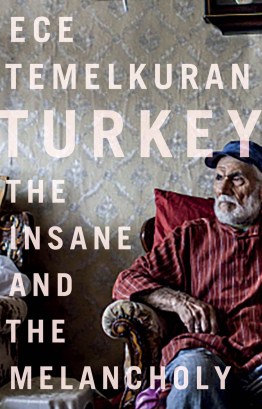
Ece Temelkuran
When I collect my book, Laura, the young woman at the bookshop, asks if I’ve a special interest in Turkey. Not really! I heard the author, Ece Temelkuran, interviewed on Radio 4 and she was interesting and fun. A Turkish journalist and writer, she lives in exile in Zagreb. Originally she’d only gone to Zagreb to take part in a book festival, but during her reading the Turkish ambassador to Croatia rose to his feet to denounce her. Straight afterwards a local publisher approached and offered to bring out her work in Serbo-Croat. On the back of these two events Temelkuran thought, Well maybe I’ll stay in Zagreb then!
Temelkuran shows the interviewer round her Zagreb flat, explaining how to set up an instant home.
Buying this book was a tribute to the radio. It’s one thing I love about my country. There is so much excellent stuff to listen to! My most peaceful moments come after the girls have gone to bed, when I’m in the kitchen cleaning, or in my office writing, and the radio is playing – alternative music on Radio 6, or jazz on Radio 2, maybe a science program or politics on Radio 4, or the football game on Radio 5. It goes on forever, the radio, a gentle, never-ending intelligent conversation, and I find myself thinking, Civilisation doesn’t get any better than this!
No, I don’t have any special interest in Turkey, or any great desire to go there, but if I did go there, I’d go to the mountains. One time I was waiting in the car park at Kirstenbosch, at the foot of Table Mountain, when a busload of Turkish tourists arrived. We got into conversation. Their attitude surprised me: they weren’t impressed with Table Mountain! You should visit Turkey, they said. Our mountains are more beautiful! Since then I’ve always wondered.
My other connection with Turkey is I work on Green Lanes – one of the most Turkish areas of London. The food in the restaurants there is shish kebabs, rice, lentil soups, pickles, cabbage salads, delicious flat breads, small cups of sweet tea and sticky pastries – really good stuff, and inexpensive. Another thing is the barbershops. I get my hair cut at a Turkish place on Green Lanes. The barbers there are professional: they concentrate on the job, which includes burning the hair in your ears, cleansing your face, and sometimes even massaging your shoulders. Wonderful! On the TV screens there are Turkish music videos playing – crooning men, moonlit oceans and scantily clad women – all quite ridiculous.
Temelkuran portrays Turkey as a bridge between West and the East. The modern history begins with Attaturk, who governed the country from 1923 to 1938 and aimed to re-make his country into a thoroughly European nation. During WW2 Turkey was neutral. In 1960 there was a left wing coup (called a revolution) but the successive coups in 1971 and 1980 were both rightwing. The current governing AKP came to power in 2002 on a supposedly democratic and inclusive platform, repudiating the military and vowing to make room for the Kurds and other minorities.
The Turkish intelligentsia seemed to swallow that line, as did the rest of the world, but the reality that gradually emerged was something more like fascism. The country’s leader, Erdogan, is a demagogue. The politics of neoliberalism are in full swing. The country has grown socially conservative, Islamic and repressive. Temelkuran uses the term ‘Dubaisation’ to describe what’s happened – fancy shopping malls, widespread poverty, imprisonment of journalists, torture of Kurds, closing of schools and an atmosphere of repression and alienation.
In the background, always, is the war in the East of the country with the Kurds and their PKK.
In short, Turkey is now more like a typical Middle-Eastern country. There was a social uprising in 2013, known as Gezi Park, after the government tried to bulldozer a central square in Istanbul. And there was an attempted coup – last year I think – which Erdogan survived and then used as an excuse for further repression. It sounds like a terrible place to live, and reading the book I felt sorry.
Temelkuran illuminates the way that fascism works – how it happens not suddenly but in stages – and how easy it is to miss. How easy to say, ‘Let’s give things a chance’ or ‘It may not be that bad.’ That’s how apartheid began in South Africa. That’s how the UK looks right now. Fascism arrives with a bag of anaesthetics.
The beauty of this book was its conversational style. It was almost like listening to the radio – or like a long evening with an intelligent person explaining their beloved country. It was a great way to get a feeling for the place.
If you want to hear Ece Temelkuran doing an interview click here

 Book Reviews by Nathan Bronx