Laird Hunt
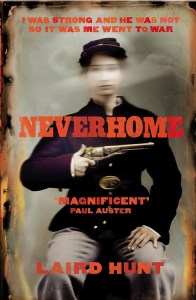 I’ve been looking for a book about the American civil war for ages, not finding one, and then this came along – an off-beat-sounding piece of fiction about a woman who disguises herself as a man – and goes off to fight. It was brilliant.
The narrator, Ash Thompson, later known as Gallant Ash (after she gives her jacket to a girl with torn skirts), is a small, tough married woman. She begins her story like this: “I was strong and he was not, so it was me went to war to defend the Republic.”
Later she elaborates: “There was one of us had to look to the farm and one had to go and that was him and that was me. We were about the same small size but he was made out of wool and I was made out of wire. He took the sick headache every winter and I’d never got sick one grey day in my life. He couldn’t see too well over a distance and I could shut one eye and shoot a jackrabbit out its ears at fifty yards. He would turn away any time he could, and I never, ever backed down.”
The language is stunning, beautiful, rich and poetical – like the language of Huckleberry Finn.
The story spins out cleverly. As the war proceeds, you learn about the past of Gallant Ash. You begin to understand why she’s so tough and ready to fight. It’s to do with her mother. You also realize that, although she’s a brutally honest gal, Gallant Ash may have a blind spot or two. When her fellow soldiers accuse her of stealing their rations, it all sounds terribly unfair, but eventually she’ll come clean to the reader.
After fighting bravely in a couple of gruesome battles, Gallant Ash finds herself recuperating at the home of a nurse – a widow – who falls in love with her. When Ash insists on returning to the fight, the nurse betrays her to the army who, for reasons we don’t understand, puts her in a brutal psychiatric prison. The rest is a journey home, culminating in a tragedy.
Reading Neverhome, I thought of a book called Muzukuru about the bush war in Rhodesia – an epic story, bursting with South African lingo (‘goffels’ and ‘putting foot’ and ‘I chune you’ etc.) that I plucked off Jeremy Nathan’s shelf at Beryl Court in 1996 and relished.
Then, as I was walking through Lerici (I read Neverhome and am writing this review in Italy) I realized that I could relate Gallant Ash, almost perfectly, to my ex-girlfriend Carletta. Not only that but I could relate myself to Ash’s husband Bartholomew.
Carletta had a background like Gallant Ash’s and the same kind of toughness – also the same kind of tenderness and the same kind of charm. And she had this talent for mimicry. She could take off people’s walks and their funny faces – and she did it from the inside out. Sometimes she had me in hysterics. And then there was her grace, her warmth, her raucous voice, the boyish way she moved and sat, her empathy for the kid at the Sainsbury counter (“Porello!”), her willingness to fight (pugnacity is just the word) and her streak of Roman craziness. It was all very Gallant Ash
The defining moment in our relationship, though, was the Portobello Road incident. It’s to there that I must return! Carletta, her sister Ilaria and a male friend (name forgotten) were having a beer outside a pub on Portobello Road when a large, drunk, Sudanese man started bothering them. That was before I arrived – and when I did things got worse. The Sudanese guy lumbered up to us, too close, and I pushed him away. He offered some incoherent curses. Next thing, Carletta throws her beer bottle at the brother. Then he punches me. We take off, at my instigation, but the man – a drunken, stumbling idiot really – pursues us and reappears by Ladbroke Grove tube station. Now there’s a situation: the drunk Sudanese is stumbling after me – his main enemy – while I’m backing away in large circles. A small crowd of young black men is watching disinterestedly, and Carletta is shouting at me in Italian: Defend yourself! Eventually, sick of my retreating, she takes up the fight herself – and receives a couple of hard kicks in her side. We slope off homeward with our injuries, trying to figure out what’s just happened. It’s clear, though, that Carletta is not only hurt but also embarrassed.
‘Why didn’t you hit him? He was attacking you! ‘
Because I didn’t want to get hurt? Because he was bigger than I was? Because he was an idiot? Because there was nothing at stake? But Carletta is hurt and ashamed, and so there’s some of this shame is mine too, however pretty my reasons.
Another conversation: ‘It’s not how big you are,’ Carletta tells me, ‘it’s how mad you’re prepared to get.’ That’s Carletta – a hardhead who won’t back down. Like the private in From Here to Eternity. Like Gallant Ash fighting her Civil War.
But it was a great book!

 Book Reviews by Nathan Bronx