Neil Postman
 I came across Neil Postman at my cousin Jeremy’s flat in Johannesburg. I was living there in 1996. Postman’s “Amusing Ourselves to Death” was one of Jem’s favourite books – so I read it too. Jem would often use the title, with a twinkle, as a catchphrase for Johannesburg’s nightlife.
In fact “Amusing Ourselves to Death” (published 1985) is a book about television. It’s especially about how television degrades our culture. The main thing, says Postman, is that TV trivialises all it touches. It’s a medium that lends itself to entertainment, which is fine for sitcoms and dramas, he says, but no good for serious stuff. The news, for example, arrives like a piece of razzmatazz. Tragic and comic items are presented in an unrelated way, so that it’s impossible to properly respond. The underlying message is always: This stuff doesn’t really matter.
There was a news satire in the UK called “The Day Today” (Chris Morris and Armando Ianucci, 1994) that got this really well: the dramatic music that went on just a bit too long, the graphics that were just a bit too elaborate.
Our political culture, Postman argues, has had to adapt to television (with the advent of sound bites etc.) and the result has been the death of proper public debate and public engagement.
I read “Amusing Ourselves to Death” on Jem’s balcony – with the city of Joburg all lit up and sparkling below. Postman’s text was luminous too. He’s a wonderful, conversational type of writer.
Jem’s flat was in an art deco block called Beryl Court, which stands on a hill in the suburb of Troyeville. He and a group of his friends had bought flats in this block in the early 1990s. It was a communal type of place – Beryl – with folks always visiting each other. The brick red, open-air walkways on the inner side of the building had a South African floor-polish smell – they overlooked a sunny car park in which laundry got washed and dried – but the flats, which were small and perfect, all looked the other way: North over the Bez Valley or West towards the City.
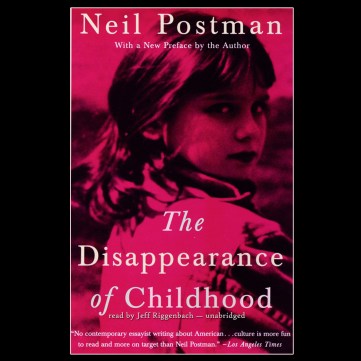
Postman’s voice stayed with me, but only lately did I read “The Disappearance of Childhood” (published 1982). Here Postman argues that (thanks to TV, again) childhood has had its day! Childhood, he says, is not a real thing anyway. Apart from infancy (which is clearly biological) it’s just an idea or a social role. And now that idea is obsolescent.
Before the printing press came along (C15), he says, children dressed like adults, did the same things as adults, and were exposed to all of adulthood’s violence and sexuality. Grown-ups, on the other hand, were rather child-like. Most people (even clerical scribes) were illiterate. There wasn’t really anything grown-ups knew that children didn’t know – so why make a big distinction?
But the printing press meant books became widespread. For the first time since classical times, there was social literacy. And book learning by its very nature created stages of development. Now there was a need for schools and universities. The advent of schools created a need for childhood. Society responded by making children more visibly different.
Postman sees the idea of childhood as one of the great achievements of civilisation. With it came the idea of protecting and nurturing and even celebrating children. But then came electricity, the telegraph, the radio and, finally, television. And TV meant a shift in the culture from one that reads to one that watches. Postman sees this as profound. Writing is conceptual and propositional. It lines up a train of thought for the reader to follow, understand and agree with or disagree with. But with TV no such thought is needed. It’s all sensation and emotion. A child can watch TV just as well as an adult can.
The stage is set for the demise of childhood. This is what Postman thinks is happening. The dividing line between childhood and adulthood has blurred. Now children wear the same clothes as adults. They know all the secrets of the adult world (sex, violence and stupidity), they have lost their manners (due to the loss of hierarchy), and their serious crime rate has risen a thousand-fold. Adults meanwhile have grown childish. They value emotions above propositions, they are dominated by advertising, and they are narcissistic etc. And remember Postman wrote all this 35 years ago! The world of 2017 does not rebut his analysis.
My own childhood took place in London – in Golders Green then Hampstead. My cousin Jeremy grew up in Maritzburg in Natal. Our mutual grandfather, Cecil, grew up right on the streets of Troyeville, around Beryl Court, in the 1910s and 20s. He was the second youngest of 7 brothers and a sister – and they all helped their mother (Annie) run her grocery store. Cecil was bookish – and excelled at Latin. Television did not start in South Africa until 1976, just five years before he died.

 Book Reviews by Nathan Bronx
This is an excellent post, man. Fascinating thoughts from you and from Postman.
I say we have to nurture our own sense of a childhood as best we can within our own families.
That’s where we have some autonomy. Inevitably, though, our kids are won over as consumers/customers!
LikeLike
Thank you for this insight…Inevitably makes one think about all other screens, smart phones, computers and social media and what this means for kids’ development. As for gender identity development, I fear this often means having to be a guy, or a girl (a man or a woman) at a much younger age. Sometimes, when you don’t fit in the dominant cultural adult heteronormative norms, there are plenty of powerful messages on screens to tell you that you may need to think seriously (and “do” something) about your gender. Many kids have immediate (and usually constant) access to such messages, and those struggling more to fit in are understandably more vulnerable. Parents find themselves being “educated” by their children. The disappearance of childhood can go hand in hand at times with the disappearance of parenthood.
LikeLike
Thanks Ioanna. Postman died in 2003 so we won’t get his take on iPads and iPhones. No doubt his take would have been interesting. On the whole he was skeptical about “technology” – he maintained it could never replace human values – so he probably wouldn’t have been a big fan.
LikeLike
Coincidence!
First I still really like your blog. Really really.
I like the poem by Philip Hancock and your bit on Neil Postman is lovely.
And the coincidence is that in 1969 I spent a couple of months with a friend in Tampa and went with her (religiously) to a graduate seminar at the university of South Florida taught by Charles Weingartner. It was a real experience. Laid back, and intellectually super stimulating. There was a social dimension to the seminar — it attracted all kinds of people but it was small, maybe 8 — 10 people. the basic subject was what to be “The Soft Revolution” and “Teaching as a Subversive Acrtvity “ which Postman and Charles Weingartner had just published. It was one of the highlights of my academic career. I had never been to university, was a free listener and having just got out of the Israeli army I felt free to say whatever the fuck I liked. And I thought I was definitely smart enough to participate in a 60’s graduate seminar. I had no idea of humility. And Weingartner was a wonderful teacher — open to anything. People built art installations before there was such a thing — rooms filled with big balloons that you had to walk or wade through.
Ok enough.
Just reporting on the pleasure of remembering that your blog gave me.
LikeLike