 Maya Jasanoff
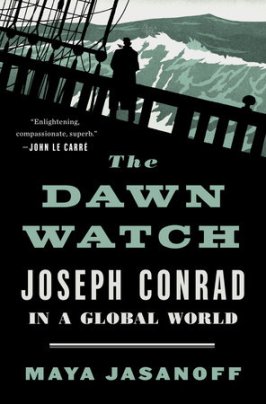
This was a Christmas present I’d requested – a gorgeous new book, still in hardback, and not too long, on the subject of Joseph Conrad and his ongoing relevance.
The author, Maya Jasanoff, is a historian rather than a literary critic and her aim was not to study Conrad’s literary achievements so much as put them into historical context. She argues that few other authors have been so prescient about the world: Conrad saw into the Belgian atrocities of the Congo before they’d really taken shape. He understood the rise of the United States and the coming of globalisation. He wrote about bomb-plots in London. Conrad was a visionary, runs the argument.
The amazing thing about Conrad was that he came to English as a second language (third language if you count French). Polish-born, he’d never set foot in Britain before the age of about 23. At that point, he arrived as a sailor to join the British merchant navy. Years at sea followed – a life that he loved. But being foreign, he didn’t get the advancement he deserved. Only in his forties did he establish himself as a writer. He made a late, happy marriage to a working-class English girl; he settled in Sussex, then Kent; he had two fine sons; and he was a point in a writer’s circle that included Ford Maddox Ford, TS Elliot, Roger Casement and Henry James. Late in his life he made an unexpected trip to America where he was received with great fanfare.
Conrad’s origins in 19th Century Poland were extraordinary. He came from a family of minor nobles – at a time when Poland was under the oppressive control of Tsarist Russia. The country was trying to establish its nationhood – and Conrad’s parents were a pair of revolutionaries. His father, a poet, lived for the day of reckoning. But it never came. There were arrests, imprisonments, exiles, privations and ruined health. His mother died when he was eleven. His father died a few years later. At fifteen Conrad was an orphan in the care of his maternal uncle.
And it was in this context, seeing the annihilation of his parents’ lives, that Conrad formed his own adolescent dream – one that never really died – of taking to the sea. Perhaps the underlying wish was just to get as far away from Poland as possible.
The maternal uncle, Teodor, was a man who saw life very differently to Conrad’s parents. Unlike them, he saw no point in fighting the Russians. It simply wasn’t going to work. The sensible thing, in his view, was to stay out of trouble, conduct one’s business affairs, and wait for the world to turn. He regarded Conrad’s father as a great, irresponsible fool. But to Conrad he offered a great deal of emotional support, and bailed him out, time and again (though with much chastising) after Conrad left Poland. In the end it was this man, and not his revolutionary parents, that provided Conrad with a model. In all his life, whatever he made of the world, Conrad never gave his name to any cause or joined a political organisation.
Uncle Teodor reminded me of my mother Gill, who grew up in Johannesburg. Her memory of the South African system is that ‘There was no point in trying to do anything. They’d just put you in prison! And then what use were you?’ Her brother, Rick, saw things differently. He was an activist – and at twenty (circa 1960) was arrested at a protest march. His father, Mike, got wind of the arrest. ‘Have you got any idea what this will do to my business interests?’ he asked furiously – a question Rick recalls with outrage. Rick was banned from South Africa for many years and transferred his activism to other left wing causes based in London.
Like Conrad, my mother wanted to get as faraway as possible. ‘It’s like a hornet’s nest to me,’ she’d say of South Africa – and shudder. She was flabbergasted when my sister Nicki and I went back to South Africa (for a few years) in the 1990s. ‘Are you a missionary?’ she asked me. I said I didn’t think so. ‘Well in that case, why are you there?’ I said I was helping to build up the country. ‘Give it a hundred years!’ she advised. ‘Then go and build it up! Africa is for the Blacks. They’ll need at least a century to recover.’ Such advice might seem a bit exaggerated, but it’s the kind of thing I can imagine Joseph Conrad saying.
Conrad doesn’t seem to have set out to become a writer. He really wanted a life at sea. However he loved England – and though he hated imperialism he seemed to believe that Britain’s empire and its people and its manners were better than any other. He believed that barbarism was always a possibility, just below the surface, in any society. He misled people about the circumstances of his life and was vague about the meaning of his art – it’s all ambiguous, all open to interpretation. He died suddenly, quite peacefully, in a cottage near Canterbury.
In her afterword, Jasanoff describes her own trip up the Congo River, which was pleasant and sociable and inspiring. She concludes times must have changed. Then she mentions Geoff Dyer and William Dalrymple among her favorite writers. Dalrymple I’ve not read but I know him as an offbeat historian. Dyer is one of my favourites, a comically brilliant English writer, though sometimes a bit of a nerd. For her part, Jasanoff is a wonderfully straightforward writer of intelligent ideas. The Dawn Watch was a total pleasure from first to last.

 Book Reviews by Nathan Bronx