Giorgio Bassani
(Translated by Isabel Quigly)
 It’s the last night of January, 2016. I’m at The Lamb with Vieri and Micòl his older daughter.
Vieri, named after a figure in Dante, is over from Parma on business. Micòl, now aged 20, is studying at the London College of Fashion. What’s nice about Micòl is her ease and openness. What’s amazing is the way she has left Italy: she has figured out her passions and followed them. Not such an easy thing to do.
When I think of myself at that age!
We’re sitting in The Lamb’s central cubicle, a kind of oak-paneled cockpit that adds to the sense of occasion. Micòl with her extravert gaze is telling us stories of the London she encounters – London, an open city – and one is held by her picturesque views and a sense of the life cycle progressing.
Around the corner, La La Land is playing at The Curzon. Have Vieri and Micòl seen it yet? I saw it right here in Bloomsbury, with Millie and Alice. It was fabulous, it was everything people said, it deserved that standing ovation at Cannes, but I especially loved watching it in a small-screen cinema in the heart of London on a blustery Saturday, one arm round each daughter.
As I think I mentioned, this is the Lamb’s central cubicle, with the buffer of the actual pub around us, and beyond the pub’s walls the beacons of the Children’s Hospital and the Foundling Museum and the Curzon Cinema, three institutions to believe in, and around that all Bloomsbury, and the West End sloping down through Covent Garden to the river, and the whole enterprise now seen through the eyes of Micòl and imbued with the spirit of a great old friendship.
Vieri asks if I still write. Do I? Eventually I find the way to my book reviews. ‘They’re a kind of hybrid,’ I explain, ‘they’re a record of what I’ve been reading but also a journal.’ To my surprise, this account stands up. ‘Like if you recommended a book, I might use it as a launch pad for talking about you.’ A couple of days later there’s a parcel: ‘The Big Short’ by Michael Lewis. It’s the best-selling story of some investor dudes who banked on the financial crash.
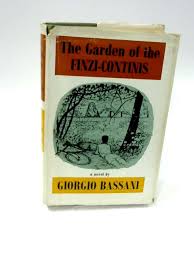
But the book I’m reviewing today is more important than The Big Short and quite a bit more moving. It’s The Garden of the Finzi-Continis, a novel by Giorgio Bassani, published by Einaudi in 1962 and featuring a main character by the name of Micòl. To be precise, this is Micòl Finzi-Contini, a young woman who in 1938 (when the novel is set) was just two years older than Micòl-in-the-Lamb. Come to think of it, Micòl Finzi-Contini, were she with us tonight, would have been exactly 100 years old.
Let’s get this straight: Micòl is named after Micòl Finzi-Contini, a fictional character in Giorgio Bassani’s famous novel.
And this too: Bassani’s novel is dedicated “To Micòl” which makes it clear that Bassani’s Micòl was a real-life, flesh-and-blood human being.
This is bewildering in a way. If Bassani wanted to tell the story of how, as a youth, he fell madly into unrequited love with an aristocratic young Jewish woman in his hometown of Ferrara, then why didn’t he just write a memoir? Like Laurie Lee’s Cider with Rosie for example? The prosaic answer must be that he wanted more leeway to invent bits and perfect the story. But the deeper answer may be that he was still so freaked out, by what eventually happened to the Finzi-Continis, that he couldn’t face telling the story straight – and so he hid behind a literary curtain.
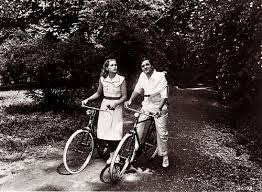
In 1938 Micòl Finzi-Contini was 22 years old and moving between Ferrara, where her family lived (in a tremendous pile of a mansion) and Venice, which wasn’t far away, where she was completing her degree in literature at the university. She was blue-eyed, razor-sharp and hilarious – and to the narrator a breathtaking figure. But what was she actually like? Well, she played a mean game of tennis. She knew every tree in the grounds of the manor (which was practically a botanical gardens). She had a phone in her own bedroom (an unheard of luxury then). She collected Venetian glass trinkets. And so on. She was sophisticated. And during the autumn of 1938 she led the callow, young Bassani – if that’s who the narrator is – on a full tour of the manor and right up the garden path.
The Finzi-Continis were an oddity within the small Jewish community (300 people) of Ferrara (to which the Bassanis too belonged). Not only were they fabulously wealthy but also they were reclusive. Their property, which must have taken up a quarter of the town, was surrounded by high walls and grassy banks, from which the family didn’t frequently emerge. Micòl and her brother Alberto were home schooled. Only on Jewish high holidays or at school exam times did the little Bassani get the chance to gawp at them. And when the Finzi-Continis got permission to start their own synagogue, it only confirmed the impression of their aloofness.
Micòl and Alberto’s father was Professór Ermanno, a kind of gentleman scholar who distinguished himself by not becoming a member of the fascist party. Amazingly, most Italian Jews had supported the fascists. That was until 1938 when Mussolini suddenly passed ‘the racial laws’ (what was known as the great betrayal) to prove himself to Hitler. And at that point the Finzi-Continis mysteriously opened their gates, inviting a number of Jewish kids, who’d been thrown out of the Ferrara tennis club, to come and play tennis on their private court. So it went: In the long Indian summer of 1938 a group of young people congregated each day to play tennis, and Bassani fell in love with Micòl, as fascism lapped at the garden’s high walls.
As I was saying, Professór Ermanno, was a kind, courteous man, devoted to his rather vague studies, his family and his pet Great Dane. In all of this he greatly resembles another Italian literary figure: the aristocrat named The Prince in Tomasi di Lampedusa’s historical novel The Leopard. How to explain such a strange coincidence? Well, perhaps all Italian aristocrats have Great Danes and do amateur research? Or else perhaps Bassani and Di Lampedusa (who knew each other) sometimes shared their paintbrushes?
In response to the invasion of Sicily by Garibaldi and his revolutionaries, The Prince makes a famous pronouncement: ‘In order for things to stay the same, everything will have to change.’ He’s willing to go against what seem to be his own interests in the expectation that he’ll get to keep his properties and telescopes. Prof. Ermanno, on the other hand, is shrewd enough to reject the Italian fascists from the outset, but not shrewd enough to see how badly it’s going to end. At one point, in a riveting monologue, Bassani’s father questions why the Finzi-Continis haven’t gone to live to Israel if they hate the fascists so much. Bassani’s father dislikes the Finzi-Continis – this family that his son finds so alluring. His ranting about them is all too credible: Jewish kitchen chatter from 1938 Ferrara.
What I’m trying to say: The situation with the Nazis was one where the Prince’s famous dictum was not applicable.
The key moment in The Garden of the Finzi-Continis comes at Pésach 1939, when the narrator – on a cold, clear night – leaves a gloomy family supper and cycles along the snowy roads to the magna domus.
The Pésach supper is gloomy because the Bassanis and their friends have all lost their jobs and positions. The narrator finds their moaning hard to bear and recalls them as ghosts – with hindsight.
At the magna domus, Micòl has just returned from a long stint in Venice and Bassani has missed her. Their relationship is still unresolved. When he asks why she has dallied in Venice so long, Micòl gives him “a sidelong glance” that does not bode well. Then he kisses her – but with a feeling that it’s all too late – and she pointedly doesn’t kiss him back.
Thus Micòl breaks Bassani’s heart, though it takes a while to play out.
Near the end of the novel, in a stunning scene, Bassani’s father talks him through the broken heart. After slagging off the Finzi-Continis (as usual) and pointing out that, really, they’re from another planet (“they don’t even seem like judîm”) he gets into something more universal: “Of course I’m sorry; I can imagine what you’re feeling just now. But d’you know, I envy you just a little bit as well? If you want to understand, really understand the way things are in this world, you’ve got to die at least once. And as that’s the law, it’s better to die while you’re young, while you’ve still got time to pull yourself up and start again… Understanding when you’re old is ugly, very much uglier.’ And what moves the reader here is that the broken-hearted young Bassani chooses to accept this advice – this very good advice – from the same ailing father whom in previous chapters he has rejected.
It must have been a turning point for Bassani. He did manage to move on. It’s only alluded to in the novel, but he joined the resistance, was caught and jailed, and survived the war. He spent the rest of his life in Rome.
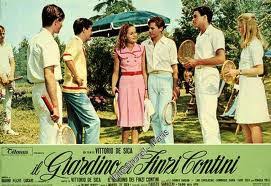 His work as a writer was a remembrance of the Ferrara community he’d come from. The Garden of the Finzi-Continis was his famous book and a movie version of it (Dir. Vittorio de Sica) won the 1970 academy award for Best International Film. I can definitely recall the hype when that movie was first screened on British TV.
I email Vieri to ask why he named his daughter Micòl and he replies as follows:
“You know that I always had some jew-ish inclinations, so maybe that’s one of the reasons I loved the book so much. Also, Micol’s character is so impressive I am surprised we don’t have more women name that way.
Are you reading it in English or Italian?”
In English! Life is too short. Then he adds this:
“Actually, it happened that “Il Giardino dei Finzi-Contini” is a book I read almost 35 years ago and I loved it.
Then, when me and Federica met, well before getting married, we learnt that we also both loved the movie (you should watch it after you finished the book), where Micol’s character is played by a very young Dominique Sanda. So, we decided that if we ever had a daughter we would have called her Micol or, better, Micòl, as she states 😉
And that’s it.”
Yes, that’s it.
How great to be named after a literary character!

 Book Reviews by Nathan Bronx
Thanks Mark!
A really pleasurable read – very nicely woven from different threads.
Am beginning to see a pattern in the way you like to always leave us with a nice one-liner.
“How great to be named after a literary character!”
Sasha was from Dr. Zhivago!
My mum was reading it whilst pregnant with men and then saw the film, in which one of the actirs was called Alexei…
But I have never actually read it, so now, thanks to you, I will seek it out…
LikeLike
Wow! There you go. In all these years I never knew that about you. I once saw the movie at the cinema with Ruth Katz, who had long adored it, it was a big weepie. As for the book (by Boris Pasternak), I believe the manuscript had to be smuggled out of Russia in cloak-and-dagger circumstances. Let me know when you’ve found out more about your namesake character. Love and Peace.
LikeLike
Yes!
Fittingly, it was smuggled to Italy.
LikeLike