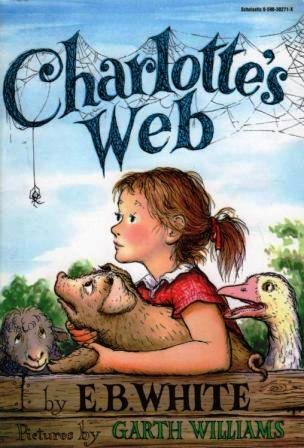
Charlotte’s Web

E.B. White

Charlottes-Web-book-cover1A few years ago I read this book with Millie – and now I was reading it with Alice. We were alternating chapters.

Around Page 58 there’s a passage about the Queensborough Bridge that sent me into a reverie. Templeton the rat is grouching as usual, and Charlotte, in her prime, is giving Wilbur one of her benevolent lectures – overheard by the ever-present Fern:

“Templeton untied his string and took it back to his home. Charlotte returned to her weaving.

‘You needn’t feel too badly, Wilbur,’ she said. Not many creatures can spin webs. Even men aren’t as good at it as spiders, although they think they’re pretty good, and they’ll try anything. Did you ever hear of the Queensborough Bridge?’

Wilbur shook his head. ‘Is it a web?’

‘Sort of,’ replied Charlotte. ‘But do you know how long it took men to build it? Eight whole years. My goodness, I would have starved to death waiting that long. I can make a web in a single evening.’

‘What do people catch in the Queensborough Bridge – bugs?’ asked Wilbur.

‘No,’ said Charlotte. ‘They don’t catch anything. They just keep trotting back and forth across the bridge thinking there is something better on the other side…’”

Now it happens that I once spent a summer living right by the Queensborough Bridge. It was 1985. Ruth Katz and I found an apartment in the New York Times – and Ruth’s ballet friend, William, helped us get it. I arrived from Toronto at the end of April and rendezvoused with David Rubin. Then we cleaned up the place, stocked the fridge, found ourselves jobs at Greenpeace, and generally had the time of our lives – until Ruth arrived from Toronto with her maelstrom.

The apartment was small, grubby and cozy – like I say with this great location beside the bridge – in a crumbling block owned by a man named Dorsey Walters. At the top was a roof from where all possible modes of human transport might be observed: boats on the East River, cable cars heading to the island, airplanes, helicopters, cars (of course) – and our fellow citizens like ants on the sidewalk.

David and I made lots of friends in a short time – some in the apartment block, others at Greenpeace: Billy Comfort, Bryan Bence, Scott Pinet, Laurel Owen, Paul Stewart, Lori and the one I actually stayed in touch with (until I couldn’t): Jim Barber.

What struck me reading Charlotte’s Web was E.B. White’s interest in the life of spiders. He takes quite a lot of trouble to get us past our natural prejudices – and then to convey the miracles of spider art. It reminded me of something I read in Richard Dawkins:  Whatever the question (How to catch prey? How to protect eggs? How to build a long-distance parachute?) spiders have the same answer: Throw out some silk! E.B. White is full of admiration.

A wonderful piece then appeared in the Saturday Guardian – in the section called “Experience” that Millie reads so avidly.  This guy wrote about adopting a baby pig, thinking it was a dwarf breed, only to see it grow into a giant. But the sweet thing was that he (and his partner) fell in love with the animal – her sheer intelligence, her loving, sociable nature – and in the process woke up to the horror of eating meat. They became vegetarians, started a blog for the pig, and got such a warm response that they opened a farm animal sanctuary. E.B. White (who wrote Charlotte’s Web back in 1952) would have loved it!

Our reading of the book spanned Alice’s eighth birthday, including my purchase for her – after much hesitation – of some stick insects. E.B. White seems to have experienced nature as everything that invested his farm in Maine. The book is full of the changing seasons and the provisional relations between men and farm animals. For us, living in the endless city, the remove is several degrees greater. Stick insects in a tank! One yearns to offer more. One sees the yearning of children to know the natural world.

Life beside the Queensborough Bridge was full of laughter. Being with David was up-lifting. The love affair with Ruth seemed so important. The friends we made were so radical, the work so significant. The city opened its arms to us – never did I feel more at home. Before long, though, the seasons changed – and I didn’t have the presence of mind to spin out that fabulous summer. I might have done. Soon, sooner than a spider’s lifetime is over, I was back in Manchester in the land of Novembers.
TURKEY – the insane and the melancholy

9781783608898

Ece Temelkuran

When I collect my book, Laura, the young woman at the bookshop, asks if I’ve a special interest in Turkey. Not really! I heard the author, Ece Temelkuran, interviewed on Radio 4 and she was interesting and fun. A Turkish journalist and writer, she lives in exile in Zagreb. Originally she’d only gone to Zagreb to take part in a book festival, but during her reading the Turkish ambassador to Croatia rose to his feet to denounce her. Straight afterwards a local publisher approached and offered to bring out her work in Serbo-Croat. On the back of these two events Temelkuran thought, Well maybe I’ll stay in Zagreb then!

Temelkuran shows the interviewer round her Zagreb flat, explaining how to set up an instant home.

Buying this book was a tribute to the radio. It’s one thing I love about my country. There is so much excellent stuff to listen to! My most peaceful moments come after the girls have gone to bed, when I’m in the kitchen cleaning, or in my office writing, and the radio is playing – alternative music on Radio 6, or jazz on Radio 2, maybe a science program or politics on Radio 4, or the football game on Radio 5. It goes on forever, the radio, a gentle, never-ending intelligent conversation, and I find myself thinking, Civilisation doesn’t get any better than this!

No, I don’t have any special interest in Turkey, or any great desire to go there, but if I did go there, I’d go to the mountains. One time I was waiting in the car park at Kirstenbosch, at the foot of Table Mountain, when a busload of Turkish tourists arrived. We got into conversation. Their attitude surprised me: they weren’t impressed with Table Mountain! You should visit Turkey, they said. Our mountains are more beautiful! Since then I’ve always wondered.

My other connection with Turkey is I work on Green Lanes – one of the most Turkish areas of London. The food in the restaurants there is shish kebabs, rice, lentil soups, pickles, cabbage salads, delicious flat breads, small cups of sweet tea and sticky pastries – really good stuff, and inexpensive. Another thing is the barbershops. I get my hair cut at a Turkish place on Green Lanes. The barbers there are professional: they concentrate on the job, which includes burning the hair in your ears, cleansing your face, and sometimes even massaging your shoulders. Wonderful! On the TV screens there are Turkish music videos playing – crooning men, moonlit oceans and scantily clad women – all quite ridiculous.

Temelkuran portrays Turkey as a bridge between West and the East. The modern history begins with Attaturk, who governed the country from 1923 to 1938 and aimed to re-make his country into a thoroughly European nation. During WW2 Turkey was neutral. In 1960 there was a left wing coup (called a revolution) but the successive coups in 1971 and 1980 were both rightwing. The current governing AKP came to power in 2002 on a supposedly democratic and inclusive platform, repudiating the military and vowing to make room for the Kurds and other minorities.

The Turkish intelligentsia seemed to swallow that line, as did the rest of the world, but the reality that gradually emerged was something more like fascism. The country’s leader, Erdogan, is a demagogue. The politics of neoliberalism are in full swing. The country has grown socially conservative, Islamic and repressive. Temelkuran uses the term ‘Dubaisation’ to describe what’s happened – fancy shopping malls, widespread poverty, imprisonment of journalists, torture of Kurds, closing of schools and an atmosphere of repression and alienation.

In the background, always, is the war in the East of the country with the Kurds and their PKK.

In short, Turkey is now more like a typical Middle-Eastern country. There was a social uprising in 2013, known as Gezi Park, after the government tried to bulldozer a central square in Istanbul. And there was an attempted coup – last year I think – which Erdogan survived and then used as an excuse for further repression. It sounds like a terrible place to live, and reading the book I felt sorry.

Temelkuran illuminates the way that fascism works – how it happens not suddenly but in stages – and how easy it is to miss. How easy to say, ‘Let’s give things a chance’ or ‘It may not be that bad.’ That’s how apartheid began in South Africa. That’s how the UK looks right now. Fascism arrives with a bag of anaesthetics.

The beauty of this book was its conversational style. It was almost like listening to the radio – or like a long evening with an intelligent person explaining their beloved country. It was a great way to get a feeling for the place.

If you want to hear Ece Temelkuran doing an interview click here

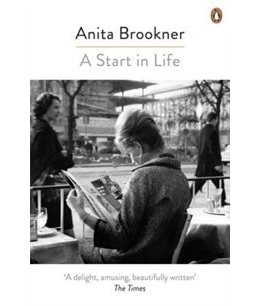
A Start in Life

0241977754Anita Brookner

Recently I read a polemic by a young French writer – a gay white male from a provincial background – pointing out that poor, black or female voices are socially excluded from the literary world. It was an abrasive piece of writing, and I didn’t agree with the author, but his words did work on me. They made me aware. I mainly read books by white, middle-aged men.

In particular I suddenly realized how few women I read. Totting it up, I can report that only 7/39 books I read in 2016 and 7/38 books I read in 2015 were by women.

On the back of this revelation, I decided to concentrate on female writers in 2017, and I went out and bought books by Anita Brookner, Beryl Bainbridge, Alice Munro, Joan Didion and others.

Anita Brookner died recently. There was an obituary by Julian Barnes. I’d never heard of her previously, but she’d been prolific and popular. Her main career had been an art historian – she’d written seminal art books. Her novel writing was more like a hobby, something she pursued in bed, while relaxing at the end of her day.

In the obituary, Brookner comes across as a quiet, self-contained woman who didn’t care for fuss or parties. She tended to arrive at a party, do a quick circuit, then get away soon as possible. But Barnes insisted she wasn’t lonely.

If this novel was based on her life, however, then Brookner may have been lonely. The main protagonist, Ruth Weiss, is a young woman in a horrendous family. Her mother, Helen, an actress, is a shallow creature forever in need of an audience. Her father, George, the son of Jewish refugees, is a silly, spoiled chap, enthralled by his glamorous wife. The only grown-up person in the group is George’s refugee mother – but then she dies. Ruth has to pull herself up by her bootstraps – and she does so by reading.

The first line says it: “Dr. Weiss, at forty, knew that her life had been ruined by literature.” The rest explains how.

A Start in Life took me back to another book: Gli Indifferenti by Alberto Moravia. That was a novel I read long ago – in Manchester – in preparation for my Italian A-Level. I didn’t like it. Written when Moravia was 21 (the very age at which I read it) Gli Indifferenti portrays a family of empty, individuals disconnected from anything meaningful. The point may have been to satirise bourgeois society.

The book I loved in my A-Level was La Luna e I Falo by Cesare Pavese. That was about an old man returning to Torino at the end of a successful life in America, touring the region, looking up old friends, in a mood of melancholy filled with bittersweet reflections. Our teacher, Vania Brown, found the book too depressing, and I knew what she meant, but I found it beautiful – it reflected my attitude.

The College of Adult Education where I studied Italian was in North Manchester. Once a week I’d cycle up the Cheetham Hill Road, stopping on the way to buy fruit, bread and feta cheese, then enjoy a couple of hours away from Medicine. Vania was a kind, warm, elegant woman married to a second division footballer – a goalkeeper. She came from Brindisi. Through her marriage she’d established herself in Manchester. For me she was a lighthouse on the dark sea of that city.

There was another person I knew at Cheetham Hill College: a young teacher called Geoff, about 26 years old. Occasionally he’d enlist me in his 5-a-side footballs games to make up the numbers.

This Geoff – I can’t remember his surname – was an awesome guy. I’d met him at the university’s McDougall Sports Centre. He was always on the tennis court, or in the sauna, or in the weights room with one of his chums. Geoff was a brilliant athlete, a Marxist, a smoker of pot, a lover of African music – and a big presence in the social world of Moss Side. He loved parties. He was an educator and an activist. He was a young man out to change the world while having fun.

Geoff had spent time in Tanzania, spoke Swahili, and was immersed in African politics. He used to organize fundraisers for Tanzania – and I used to help out by selling tickets. Great music, gentle people, a bit of puff – I was so proud to be part of it.

When I wanted to learn Setswana (for my elective in Botswana), Geoff fixed me up with a Tswana Mathematics post-grad (named Fix!) to teach me the lingo. Fix was not a great teacher, but I was an excellent student, so it worked.

The problem with both A Start in Life and Gli Indifferenti is the lack of empthy one feels for the characters. That is, apart from for Ruth, who is such a good, kind girl – only so unlucky with her family! If only she could fall in love and get away! But her family keeps pulling her back.

For the narrator of La Luna e I Falo I felt a lot of empathy – he was sad in the same way I was sad – and for Vania and Geoff I felt great admiration.

When I was leaving Manchester, though, I made a great mistake.

Geoff had been the DJ at my farewell party. Afterwards he asked if he could have one of my posters as a present. It was a Partita Communista Italiana (PCI) poster of the liberation of Milan in 1945 with the legend “Mai piu fascismo, mai piu guerra.” It was a great poster and I should have given it to him. Of course. But I didn’t. For some reason I said No and have regretted it ever since.

Gone to Ground

51BKAv7LZ8L._SX308_BO1,204,203,200_Marie Jalowicz Simon

Have I ever told you my Jack Metzger story? OK then, here goes…

I was about ten years old and Jacky had come to my parents for supper. He was visiting from Israel. As we sat down to eat, the conversation turned, as it often does in Jewish homes, to the Holocaust. I wanted to join in. ‘If I’d been in Germany,’ I ventured, ‘I’d have pretended to not be Jewish.’ At this remark, Jacky went ape-shit. He turned on my father: Ted, how could you raise a son to say something like that? Dad wasn’t fussed – or didn’t seem to be – but I felt ashamed – even though I didn’t understand what I’d said wrong

During The War, however, Marie Jalowicz Simon did exactly that: she pretended not to be Jewish, right in the heart of Berlin. Sometime in 1942, after working as forced labor in the Siemens factory, Jalowicz found a way to get sacked from her job. Then she removed her yellow star and went to ground.

Such people, submerged in the Third Reich, were known as U-boats. They survived through tenuous networks of support, moving between temporary homes, sometimes staying with opponents of the Nazis, sometimes with blackmailers or with weirdoes. In the case of Jalowicz, there were a number of unwanted (but unavoidable) sexual relationships – and it probably helped that she was young, charming and pragmatic. Many other U-boats lost their nerve at some key point. Many were denounced by neighbors, informants or fanatical Nazis.

I remember Talia Goshen telling me about her grandmother, who at the time was alive and well and living in Israel – and mentioned by Talia and Sasha as a much-loved, warm, enlightened woman. Like Jalowicz she’d gone to ground – only in the forests of Romania. ‘I don’t know how she managed it,’ said Talia, ‘one doesn’t ask. I expect she did whatever she had to.’

As an old lady, looking back, Jalowicz stressed the importance of luck. Hers involved several key people but above all a working class Aryan couple, Hannchen and Emil Koch, who happened to have purchased the Jalowicz country cottage outside Berlin. Frau Koch lent Jalowicz her own identity document – and several times found places for her to stay. And yet Koch emerges gradually (to the reader as to the young Jalowicz) not only as a resistance hero but also as a very creepy woman.

The world is full of thrilling stories, but what elevates Gone to Ground is the intelligence of the storyteller. To read the book was to fall in love with this young woman. The afterword is that the book was composed by her son, Hermann Simon, a historian, based on a series of taped interviews he did with her in the early 1990s. After the war, Jalowicz decided to remain in Berlin, realizing that what happened in Germany might have happened anywhere, if only the mob was stirred up; and that, really, Berlin was where she came from – and she didn’t have the energy to start over. So she stayed in Berlin (actually East Berlin), married an old friend from her high school, and became a professor of classics. Never did she openly discuss the war years. But when her son arrived with his tape recorder, all those years later, and said it’s time to talk, she talked – and apparently it flowed over 90 consecutive hours, all perfectly constructed, and without a single factual error when Hermann cross-checked it.

When Jalowicz first went to the Siemens factory (aged only 18 years old), she began to spend her spare time walking. Everything might depend on her knowing her city. One day, chancing on a café full of Jewish men idling and kibitzing – doing nothing, really, but wait for their deportation orders – she experiences a great urge to split away. It’s a really powerful moment. She describes too, and with a kind of contempt, the almost jolly mood of preparation that came over people who had had their deportation orders. One realises that unlike them the young Jalowicz is emphatically not in denial. She senses how this will end and her attitude is defiant.

A moving scene: at the end of the war Jalowicz is interviewed for some kind of permit by a German U.N. guy – a gentleman of obvious decency and culture who uses a tense – the subjunctive – that she’s not heard for three years. Jalowicz has spent the war years with strangers, watching every word that she says. Now the subjunctive signifies a relaxation and her emotions start to flow again.

In 1982 I was travelling around Israel with Nicki, Sivan and Paul Scanlon. We were waiting for a bus at Jerusalem Station, sitting on the curb in the summer heat. Beside us, also waiting for a bus, sat a lanky, bearded soldier. Though he didn’t recognise me, I recognised him: he was Jack Metzger. I ventured to introduce myself. He jumped up. ‘Ted Nathan’s children in Israel – this I don’t believe!’ Forty years after Marie Jalowicz skipped her deportation orders, Jack Metzger had answered his army call-up.

It is 1946. Jalowicz sweet talks an apartment out of the administration and trundles down her few belongings. On the way she vows that: (i.) She will never marry a man who isn’t Jewish. (ii.) She would rather be alone than marry a man without higher education. (iii.) She will be honest and good – like her parents had been. Moreover, she will never speak about ‘The Germans’, as if that were one thing. No, she will always make distinctions. This is a key to this book, and one reason why I read it in the first place. Fascism is always a danger – everywhere, now as ever.

The Cultural Lives of Whales and Dolphins

9780226895314Hal Whitehead and Luke Rendell

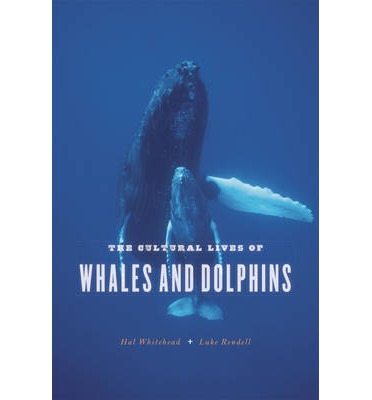
I got this book for Christmas from Anna and it was my equal best present – equal to a pair of lovely reading glasses from Ted and Gill that I’m scared to wear in case I lose them. It’s a beautiful hardback with an ocean blue cover, featuring a humpback whale calf, vertically nestled by its mother under her huge flipper.

Humpbacks are baleen whales with distinctively large flippers. They have a behaviour called breaching in which they surface at full speed, then crash back into sea with a bang. Is it to look around? To cool the blood? To impress the females? Or just playing? There are different theories. Anyway I saw humpbacks when I went on a whale-watch at Cape Cod in 1985, and it was brilliant. I was with David Rubin and some other members of the New York Greenpeace crew: Bryan Bence, Scott Pinet, Mark Beta, Billy Comfort, Sweet Lori and Paul Stewart the Welshman. We’d spent an afternoon canvassing and next day, in cool, damp weather, went on a whale watch. It was the best of times.

When I’m playing the if only game, I wonder if I might have carried on at Greenpeace for a few years, roaming the prairies of America – instead of rushing back to Sea World Britain and a lifetime of captivity.

Humpbacks are famous for their songs too. This became a big thing in the 1970s, when somebody released a recording of humpbacks. Then people heard their haunting melodies for the first time. It was a cultural episode, almost a B-side to the first moon landing, and suddenly people saw whales in a different way. This coincided with the start of the anti-whaling movement – for which Greenpeace became famous.

Humpback songs are the most elaborate and lengthy of all whale songs, with cycles lasting for hours, and perfectly reproduced each time. The songs seem to be to do with mating – because it’s only the males who sing. Other whales also sing (some with clicks), but not with the range of humpback sounds and harmonies.

According to Whitehead and Rendell, the oceans are noisy places – due to the singing of whales. They would have been noisier before whale populations were so reduced by humans. The abilities to vocalise and hear well are mammalian adaptations that the ancestors of whales developed further when they went to sea. Underwater, light doesn’t get far – so it’s hard to see – but sound travels faster than in air. Whales use this. Their vocalisations can carry hundreds of miles.

In their evolution, whales developed systems of echolocation that enable them to have a very precise three-dimensional picture of their surroundings. The whale that has really excelled is the sperm whale, whose enormous nose, occupying a third of its body, is a sophisticated piece of sonar apparatus.

Indeed the sperm whale is a freak. It’s a toothed whale, like the killer whale and the many kinds of dolphin, but early branched off the family tree. The sperm whale has the largest brain of any animal in the world – much of this perhaps relating to echolocation. They dive incredibly deeply, for up to an hour, and they are intelligent, sociable, wonderful.

Sperm whales are sometimes preyed on by killer whales, which Whitehall and Rendell describe as the top predators in the ocean. There’s a lot about killer whales in this book. They too are very sociable creatures. They are matrilineal (stick in family groups headed by a female), picky eaters (stick to one preferred type of food, be it fish, or mammals) and hostile to outsiders. They are fearsome, cooperative hunters and their emergence, ten million years ago, seems to have coincided with the extinction of many other whale species.

Some basic taxonomy: Ocean dwelling mammals are in three groups: (i) The Pinnipeds (seals and sea lions and walruses). (ii) The Sirenians (manatees and dugongs) that are related to elephants, eat plants, swim slowly and never leave the water. (iii) The Cetaceans. The Cetaceans are divided into toothed whales (inc. dolphins and porpoises) and baleen whales. The latter sieve the sea for fish and krill etc.

A central purpose of Cultural Lives is to argue that whales, like human beings, have culture. The authors define this as the ability to learn socially and to develop new and local innovations that spread through the population. They give many good examples of this – like the way that whale songs evolve and spread, rather like a fashion, or the way that different pods of killer whales or dolphins may differ in their hunting habits. However for me it seemed an unnecessary argument – it was what I would have expected.

Despite the hype this book has received, it’s prose lacked the grace of its subjects. Remember that Richard Dawkins picked the authors for The Oxford Book of Modern Science Writing on the basis that they were good writers.


We are all completely besides ourselves

Karen Joy Fowler

515Qx-griFL._SX324_BO1,204,203,200_This book was so up my street it practically fell through my letterbox. It’s the story of a girl who was raised with a chimpanzee. It’s fiction, but based on real-life stories in which people took in chimpanzees as pets or as psychology experiments.

The narrator, Rosemary, is a woman looking back on a family tragedy that began when her sister, Fern, a chimpanzee, began acting dangerously and had to be given away. At the start, Rosemary and Fern are both five years old. Rosemary’s father is an academic psychologist. Her brother, Lowell, is a teenage basketball star – and so affected by losing Fern (and especially by not being told that she’s been sent to a laboratory) that he runs away to join the Animal Liberation Front (ALF). Rosemary, bereft of her sister, and half chimp in her social demeanor, spends her childhood both pining for Fern and trying to put her monkey self behind her.

Lowell is soon a wanted man, so he sends home only anonymous postcards. Eventually he reappears in Davis, California, where Rosemary is now at university. When the siblings catch up, Lowell explains the anger that has driven his life’s work – and he cites, for example, the car crash experiments in which “conscious and terrified baboons” are subjected to “repeated, horrific and excruciating blows to the head.” He is a bit crazy by now and he seems to blame Rosemary for getting rid of Fern.

Now it so happens that in 1986 or 1987 – as a pre-clinical medical student at Manchester University – I attended a special evening lecture on exactly such baboon experiments. I was with either Chris Thurnell, or Chris Tackaberry, I can’t recall which, pretending to be a keen young medical student. In my case this was beyond far-fetched, but the evening was traumatic.

The lecturer was a celebrated physiologist who was busy perpetrating the crimes that Lowell cites. I was shocked to the core. I was twenty-two years old. I’d read (and loved) The Soul of The Ape by Eugene Marais (on the human-ness of baboons). I’d seen baboons in the wild in South Africa. And yet, in the lecture theatre, there was not a word, not a single word, of dissent. The horror! The darkness at the heart of Science! But did I put up my hand? Did I rise to answer this modern-day Kurtz? Even now, all these years later, on the train platform, or coming out of Sainsbury’s, I can find myself rehearsing the stand that I wasn’t able to make. Never did I feel moral outrage so clearly. And I still feel it. But was it the experiments that bothered me? Or was it not speaking out? I think it was the latter. Lowell is quite specific: to be a member of the ALF you have to do something.

Karen Joy Fowler’s book is really about a little girl who loses her sister. Now she is at a crossroads, finishing college, and the childhood memories are flooding back:

“It is clear that Mom loves Fern best. I can see half of Fern’s face. She is almost asleep, one eye fluttering, one ear blooming like a poppy from her black fur, one big toe plugging her mouth so I can hear her sucking on it. She looks at me sleepily from over her own leg, from around the curve of Mom’s arm. Oh, she has played this perfectly, that baby who still wears a diaper!”

Fowler has done a lot of research on chimpanzees and the book is a brilliant mix of science and drama. Rosemary, the narrator, is “impulsive, possessive and demanding”, traits she now recognises as “classic chimp”. Later she makes a wild friend, Harlow (Rosemary has a lot of trouble making friends), with the same traits. The book has the traits too! It jumps around, it grabs you, it cuddles up to you – and it swings you from psychology to animal rights to old-fashioned heartbreak. It’s well done.

I’d just finished reading Charlotte’s Web with Alice, so I was amused that Fowler used that book as a reference point. Fern is a chimp instead of a girl. Templeton is a dog instead of a rat. Initially I thought that Fowler was juxtaposing the bucolic kindness of Charlotte’s Web with the cruelty of apes used in science. Then I remembered the real story of Charlotte’s Web: Wilbur’s desperate attempts to avoid the slaughterhouse. Really both books are about the power we wield over animals.

One last connection: The early part of the story is set in Bloomington, Indiana, which was the setting for a famous movie called Breaking Away. We loved this movie as kids. It’s about a suburban boy so caught in the romance of cycling that he believes he’s Italian. (And I identified with that!) It’s also about the tense relations between the posh college kids (from out of town) and the local working-class kids (known as “cutters” because their dads work in the local quarry). In summertime, the kids (rich and poor) all go swimming in the turquoise waters of the flooded quarries.

In the summer of 1985, David Rubin and I took a drive-away from Indianapolis to Chicago, and on the way stopped in Bloomington, and swam in the quarries. It was exactly like the movie! Fowler has Rosemary mention the excitement that the movie caused in the town. All this added to my feeling I’d found a lost sister.

Muhammad Ali

The Birth of a Legend, Miami, 1961-1964 

Flip Schulke with Matt Schedule

51W3K2GBGFL._SX258_BO1,204,203,200_This book suddenly appeared in the coffee-table section of QP Books before Christmas and was irresistible. I briefly considered buying it for David as his present, but in the end decided not to mess around and got it for myself
Amen!

It is a beautiful book – and it complements the other great Ali photographic volume whose name I’ve temporarily forgotten. (It’s “I am King”, I just checked.)

The book is a batch of photos that Schulke took of Ali in the interval between his becoming Olympic champion (1960) and his defeating Sonny Liston (1964) for the World Championship.

I knew the story already: Clay arrives in Miami to train with the already legendary Angelo Dundee and grows into the finest heavyweight and the most outrageous self-promoter of all time. The photos, though, are just something else. Clay was astonishingly handsome! And pure and fresh and light! And although he was to become more complex – deeper, battle scarred, politicised, ingenious – these, somehow, are the photos: Cassius Clay the perfect athlete, poised on the brink of his eternal greatness.

About ten years ago Audrey Brown invited me to an Ali photo exhibition at a gallery by Embankment. I guess she knew I was an Ali fan – she was one too – and she encouraged me to buy a picture for myself. I would have done, even though they cost £300 each, except that they featured Ali with what looked like business associates – all men in suits and Ali big and heavy – probably some time after his exile – and I didn’t really fancy them so much.

These youthful pictures I would have bought!

Schulke had a super-interesting career in photography – centered on his pictures of the Civil Rights movement – but this was the only time he ventured into boxing. In fact, he hadn’t even heard of Clay when he was sent (by Sports Illustrated) to shoot him at the 5th Street Gym in Miami. When he got there he immediately was bowled over by the charm of the young boxer. The two men (Schulke was aged 30 and Clay 18) seemed to click. Schulke took Clay shopping in downtown Miami – where staff refused to let Clay try on the shirts – Olympic champion or not – and then Clay, knowing that Schulke specialised in underwater photography, came up with the idea of a photo shoot at his hotel swimming pool.

Thus the extraordinary sequence of pictures of the young Greek God underwater – striking attitudes, blowing bubbles, horsing around. He’d kidded Schulke (who’d believed him) that this was how he did his boxing training: In the water!

The most memorable picture though is Cassius Clay running along the causeway that connects Miami to Miami Beach – with the ocean in the background and beyond that the hotels – and Clay wearing trousers and army boots – his usual running gear.

All of it – the whole book in fact – shot in stunning 1960s black and white.

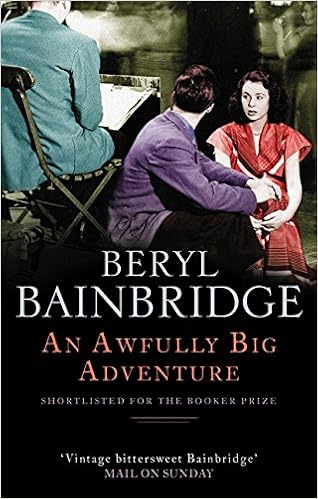
An Awfully Big Adventure

By Beryl Bainbridge

This is my year for reading women, and I had to start somewhere, so I bought books by two older British novelists, both deceased but still often mentioned: Anita Brookner and Beryl Bainbridge.

Both have been profiled in the Guardian recently, Brookner because she died, Bainbridge (I think) because someone had written her biography. However the point about the Bainbridge profile was the wild and emotionally distraught life she had led – and how she somehow just kept on writing through so many affairs and disappointments.

If I remember, the saddest bit was hearing that near the end of her life Bainbridge had fallen for some young fake admirer who conned her out of her savings. She was needy – that was the gist of the profile. Yet in her Wikipedia entry, it says that by the end of Bainbridge’s life – she died in 2010 – she’d become a “national treasure.”

Brookner and Bainbridge make an interesting pair. They were almost exact contemporaries. Brookner was born in 1928 in Herne Hill, the only daughter of Jewish immigrant parents (the Bruckners), while Bainbridge was born in Liverpool in 1932 into what sounds like a quirky, working-class background.

The Liverpool connection means something. Some of my closest friends originate in that city. David’s father (Ron Rubin) and Pat’s mother (Brenda Turner) are also exact contemporaries of Bainbridge. I wonder if they knew her?

Some of my own ancestors passed through Liverpool on their way to the New World, and others actually remained in Lancashire when the party was over. All this appears on a family tree that my Uncle Lawrence has distributed. When I showed it to David, we got to thinking that our families must have known each other – round about 1900. The Jewish community in Liverpool wasn’t so huge.

An Awfully Big Adventure is the story of a 16-year-old girl, Stella, getting taken into a Liverpool repertory theatre. It’s an extremely funny book. The actors of the company are the cast of the story – and the comedy is their foibles and behind-the-scenes melodramas as they put on a series of plays for the season. Stella is a strong-willed, feisty piece of work – abandoned by her mother, adopted by her loving Uncle Vernon – and she sees the theatre as her only chance (“It’s either this or Woolworths”). Once arrived, she settles in quickly, falling in love with the affected stage director, Meredith Potter. (He’s gay, but she can’t see this.) The deeper drama, though, is about the celebrated actor, O’Hara, with whom Stella has a mysterious connection.

Beneath the comedy is a sad and poignant story of a girl who has lost her mother. Stella has always been given to pretensions and make-believe. She invents stories. She can be haughty, dramatic – or very dismissive. Throughout the book, she spurns her Uncle Vernon and his wife, Lily, both of whom are trying so hard to back her. Bainbridge spins this out beautifully and finally reveals the backstory.

The macabre element – threaded all the way through but never fully exposed – is that O’Hara may be Stella’s father. When he joins the company and seduces Stella we may disapprove, but we indulge it because Stella seems to be in control. However the story is heading for something far more shocking than a bit of sexual exploitation.

Bainbridge’s An Awfully Big Adventure (1989) and Brookner’s A Start in Life (1982) both look back to the 1950s – when England was empty, bare and shabby and the War was recent trauma. From 2017 this seems like another world. And yet it doesn’t. Both books extend just a bit beyond my own living memory.

People write from their own experience, so it’s easy to relate each fictional girl to her creator. Bruckner’s Ruth is sad, self-contained, practical and undemanding. Love will pass her by – and she’ll accept that without screaming. Bainbridge’s Stella is ambitious, outrageous and complex – and she shall have drama wherever she goes.

Now see the photos of the mature authors, Anita Brookner and Beryl Bainbridge. Brookner looks unmarked, a neat, trim little woman with short, light hair and a reputation for holding herself aloof. Bainbridge, on the other hand, with long, dark hair and sultry brown eyes, looks careworn – her ruddy skin bespeaking major nicotine use – and carrying, as we know, this wild child reputation – surely not so far from Stella.

Which author did I prefer to read? Bainbridge by a million miles. An Awfully Big Adventure is imbued with brilliant humour – this must have been Bainbridge’s saving grace – not to mention fine observation of a large cast of characters, in what is really a short book. Beneath the surface lurks a frightening tragedy, that’s true, but Bainbridge’s route is through comedy – and I loved that.