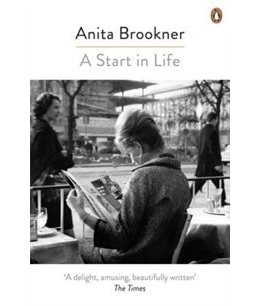
 Anita Brookner
Recently I read a polemic by a young French writer – a gay white male from a provincial background – pointing out that poor, black or female voices are socially excluded from the literary world. It was an abrasive piece of writing, and I didn’t agree with the author, but his words did work on me. They made me aware. I mainly read books by white, middle-aged men.
In particular I suddenly realized how few women I read. Totting it up, I can report that only 7/39 books I read in 2016 and 7/38 books I read in 2015 were by women.
On the back of this revelation, I decided to concentrate on female writers in 2017, and I went out and bought books by Anita Brookner, Beryl Bainbridge, Alice Munro, Joan Didion and others.
Anita Brookner died recently. There was an obituary by Julian Barnes. I’d never heard of her previously, but she’d been prolific and popular. Her main career had been an art historian – she’d written seminal art books. Her novel writing was more like a hobby, something she pursued in bed, while relaxing at the end of her day.
In the obituary, Brookner comes across as a quiet, self-contained woman who didn’t care for fuss or parties. She tended to arrive at a party, do a quick circuit, then get away soon as possible. But Barnes insisted she wasn’t lonely.
If this novel was based on her life, however, then Brookner may have been lonely. The main protagonist, Ruth Weiss, is a young woman in a horrendous family. Her mother, Helen, an actress, is a shallow creature forever in need of an audience. Her father, George, the son of Jewish refugees, is a silly, spoiled chap, enthralled by his glamorous wife. The only grown-up person in the group is George’s refugee mother – but then she dies. Ruth has to pull herself up by her bootstraps – and she does so by reading.
The first line says it: “Dr. Weiss, at forty, knew that her life had been ruined by literature.” The rest explains how.
A Start in Life took me back to another book: Gli Indifferenti by Alberto Moravia. That was a novel I read long ago – in Manchester – in preparation for my Italian A-Level. I didn’t like it. Written when Moravia was 21 (the very age at which I read it) Gli Indifferenti portrays a family of empty, individuals disconnected from anything meaningful. The point may have been to satirise bourgeois society.
The book I loved in my A-Level was La Luna e I Falo by Cesare Pavese. That was about an old man returning to Torino at the end of a successful life in America, touring the region, looking up old friends, in a mood of melancholy filled with bittersweet reflections. Our teacher, Vania Brown, found the book too depressing, and I knew what she meant, but I found it beautiful – it reflected my attitude.
The College of Adult Education where I studied Italian was in North Manchester. Once a week I’d cycle up the Cheetham Hill Road, stopping on the way to buy fruit, bread and feta cheese, then enjoy a couple of hours away from Medicine. Vania was a kind, warm, elegant woman married to a second division footballer – a goalkeeper. She came from Brindisi. Through her marriage she’d established herself in Manchester. For me she was a lighthouse on the dark sea of that city.
There was another person I knew at Cheetham Hill College: a young teacher called Geoff, about 26 years old. Occasionally he’d enlist me in his 5-a-side footballs games to make up the numbers.
This Geoff – I can’t remember his surname – was an awesome guy. I’d met him at the university’s McDougall Sports Centre. He was always on the tennis court, or in the sauna, or in the weights room with one of his chums. Geoff was a brilliant athlete, a Marxist, a smoker of pot, a lover of African music – and a big presence in the social world of Moss Side. He loved parties. He was an educator and an activist. He was a young man out to change the world while having fun.
Geoff had spent time in Tanzania, spoke Swahili, and was immersed in African politics. He used to organize fundraisers for Tanzania – and I used to help out by selling tickets. Great music, gentle people, a bit of puff – I was so proud to be part of it.
When I wanted to learn Setswana (for my elective in Botswana), Geoff fixed me up with a Tswana Mathematics post-grad (named Fix!) to teach me the lingo. Fix was not a great teacher, but I was an excellent student, so it worked.
The problem with both A Start in Life and Gli Indifferenti is the lack of empthy one feels for the characters. That is, apart from for Ruth, who is such a good, kind girl – only so unlucky with her family! If only she could fall in love and get away! But her family keeps pulling her back.
For the narrator of La Luna e I Falo I felt a lot of empathy – he was sad in the same way I was sad – and for Vania and Geoff I felt great admiration.
When I was leaving Manchester, though, I made a great mistake.
Geoff had been the DJ at my farewell party. Afterwards he asked if he could have one of my posters as a present. It was a Partita Communista Italiana (PCI) poster of the liberation of Milan in 1945 with the legend “Mai piu fascismo, mai piu guerra.” It was a great poster and I should have given it to him. Of course. But I didn’t. For some reason I said No and have regretted it ever since.

 Book Reviews by Nathan Bronx
There is little I enjoy more than a good biography and even a bit better a good autobiography, next in the TBR pile is Agatha Christie’s autobiography. However, based on this post I have ordered A Start in Life. Encountering a new author is a double edged sword. My bookshelves are already groaning, I ran out of room a long time ago and there are so many good books, so little time… At least one of my cats, Colette, is a voracious reader and comes running the second she sees me pick up a book.
LikeLike