Ursula Moray Williams
I’ve been 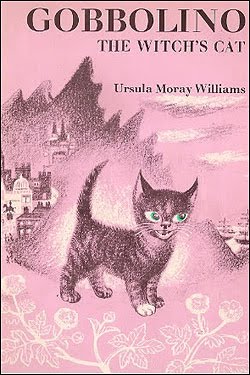 meaning to read this book for 46 years and now here I am reading it and falling asleep.
When we joined Fitzjohn’s Primary School, in 1970, my sister Nicki’s class read Gobbolino and my class read Adventures of the Little Wooden Horse. Both books were by Ursula Moray Williams – published in 1942 and 1939 respectively. Little Wooden Horse was a captivating story, set in the villages and forests of somewhere in Europe. As for Gobbolino, I remember that Nicki, then aged 5, was swept up – initiated to some kind of magical world that, for a while, took her over completely.
So now, all this time later, my younger daughter, Alice, and I are in bed with Gobbolino, reading Nicki’s original copy – a lightweight Puffin paperback. It’s got the sweetest little pink cover. See above. It’s taken work to bring Alice round to this. She must have rejected the book about a dozen times. Then suddenly she agrees – with no rhyme or reason. And now my voice trails off and the book wriggles out of my hands and Alice is pushing my shoulder. ‘Dad! Keep reading!’
One day, when I’m an old man, not long from now, in the flap of a butterfly’s wings, I could look back on this as the happiest of times – falling asleep with a book and a daughter.
Another scene: It’s dawn – a September morning. I’m writing in my little East-facing office, enjoying the peace. My routine, ever since the summer holiday: Get up at five. Make a Nescafe. Write and putter. It’s good for the soul. By the kids’ bed-time, however, I’m rather sleepy.
Gobbolino is a little cat born into the wrong family. From the moment he can think, as he tumbles out of the family cavern, he knows he isn’t meant to be a witch’s cat. No, he wants to be a kitchen cat. His idea of happiness is a warm hearth, a cozy armchair, and a kindly master. He’s not keen on his mistress, a conventional witch on a broom, nor in step with his mother, Grimalkin, or his sister, Sootica. Both are regular witch’s cats. Gobbolino also has some physical incongruities. Instead of being completely black, he has a white paw. And instead of green eyes he has brilliant blue eyes. Consequently, every witch in the Hurricane Mountains rejects him for an apprenticeship. Poor Gobbolino is abandoned on a hillside. He cries for a while – and then it comes to him: “He could go out into the world whenever he pleased and find a happy home to live in for ever and ever.”
The sky has turned pink. Outside my office window are two rows of small, urban gardens. Not so long ago, these were back yards, overflowing with children from large Irish families. But this is a gentrified neighborhood. Now each family has exactly two kids. And the gardens are works of art. Except next door. Next door has four kids instead of two and a briar patch for a garden. A different kind of art! An installation of exuberant brambles! Thrusting skywards, pushing the fences, straining to get out. This little box of wilderness is strangely compelling.
And it’s where the foxes live.
Gobbolino never has trouble finding new owners. For him that’s the easy part. The difficult part is getting people to keep him! Pretty soon, he always gets cast out: By the farmer’s wife; by the orphanage; by the Lord Mayor’s wife; by the Cat Maniac; by the Merchant Seamen; by the Little Princess; by the Travelling Showman; by the Girl in the Tower; and by the Woodcutter’s Grand-daughter. The problem is that Gobbolino can talk. The problem is that sparks fly out his ears. Sparks fly off his fur. He has a number of such odd behaviours. Result: there’s always someone denouncing him for a witch’s cat. And then poor Gobbolino must say goodbye, dust himself off, and once again, hit the forest path.
Two things about Gobbolino: One, he is a cat of great integrity. You need to read the book to understand this. Two, he has very little self-pity. Feeling sorry for himself is not Gobbolino’s style. In this regard, he’s a great example of how to live.
In our home, we have no pets – not since I returned the stick insects to the pet shop – but we do have wildlife! There’s a queue of goldfinches at the seed-feeders. There are sparrows, blue tits, robin red breasts and wood pigeons, blackbirds (the best singers) and magpies (the cleverest) and squirrels burying nuts.
But the foxes! Ah! The foxes! They are magical.
The Woodcutter’s Granddaughter, a vain, ungrateful girl, sells Gobbolino to a peddler woman, who traffics him back to the Hurricane Mountains. Now what? Gobbolino is back to Square One. He is reunited with his sister, Sootica, in the homestead of another witch. But here’s drama! Gobbolino stops co-operating! He sabotages the nasty projects of his nasty new mistress. In revenge the witch casts a spell on Gobbolino: She turns him into a kitchen cat!
6-45 a.m.: As we arrive in our kitchen for breakfast, we run straight into the foxes. Two of them: A mother and a cub. Staring right through the glass of the patio doors. They are healthy, glossy, sharply defined – as vivid as a pair of tigers. The mother springs onto our garden table. Millie starts filming with her iPhone. Now the mother is chasing the cub round the garden. Faster and faster they run. Sparks are flying. Flying off the cub’s ears and fur. A trail of bright orange sparks falling over the lawn. Suddenly the foxes stop. The cub ducks beneath the fence. Into the briar patch. The mother yawns, scratches her neck with a hind paw, picks up a tennis ball.
The witch takes away Gobbolino’s magic: his sparks and his power of language. Gobbolino doesn’t mind, for now he is easier to accept. Cast out again, he soon finds the happy hearth he always wanted. I read the final words, close the pink cover. ‘Well, what did you think?’ I ask Alice. ‘Good,’ she says. I say, ‘Shall I read about the lady who wrote it? She sounds very cool.’ ‘No,’ says Alice.


Was a very good idea to write about Gobbolino!
LikeLike
I remember this book very well indeed. In fact all books about witches and their accoutrements made quite the impression on me
LikeLike