 Frans de Waal
Sunday evening. The first episode of Blue Planet 2 has started. Alice and I are settling down. It’s the television event of the week. The BBC has filmed the creatures of the deep again – and we’re about to enter their worlds with Sir David Attenborough.
Watch this! A tropical fish is heading across a coral reef, making its way, purposefully, to the reef’s edge. The fish is about a foot long with a bright-blue front, speckled face, white flanks and yellow fins that somehow go together perfectly. It’s a tusk fish – with protruding teeth. Every morning this busy creature makes the very same excursion to the edge of the reef. What is it doing?
The tusk fish rummages in the rocks and sand. It dislodges some rocks and finds a clam. Aha! It picks up the clam in its mouth and swims back, purposefully, to the middle of the reef, where it stops at a bowl-shaped rock that Attenborough terms its kitchen. Workshop might be a better word. The bowl-shaped rock contains a sharp edge on which the tusk fish bashes the clam. Eventually the clam busts open. “A fish!” exclaims Attenborough in his most wonderful voice: “A fish that uses tools!”
Tool use is the hallmark of the human being. Or at least it used to be! Then it was noticed that chimpanzees use tools, and then other primates, and then parrots and now… a tusk fish. As the crows in Dumbo would put it: now you’ve seen jus’ ‘bout everything.
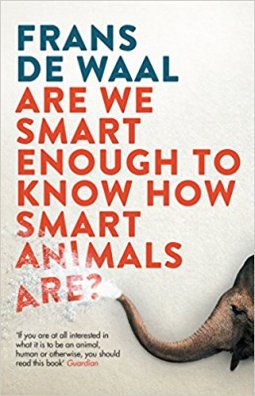
Other marks of human uniqueness, de Waal explains in this lovely, short book, have gone the same way: Language; Empathy; Altruism; Planning for the future; Play; Laughter; Postponement of pleasure; Self-recognition. In the end they always pitch up somewhere else.
My favorite is the moral sense – the sense of fairness – that occurs in both apes and monkeys. De Waal cites a very informative experiment in which a chimpanzee is happily rolling tires in return for pieces of cucumber. When a second chimpanzee is allowed to join in – and rewarded with bananas for doing the exact same work – the first chimpanzee is indignant. Chimps prefer bananas to cucumbers. The first chimpanzee has a major tantrum and refuses to take any further part.
The perplexing issue, for de Waal, is why human beings are so obsessed with proving their uniqueness in the first place.
De Waal is the people’s primatologist. He’s like the Desmond Morris for our age. Two other books by him I’ve read are The Age of Empathy (2009) (about empathy in non-human species) and the astonishing Chimpanzee Politics. (1982). The latter chronicles several years in the life of the chimpanzee colony at Arnhem Zoo. It’s extremely dramatic – particularly the group’s nail-biting leadership struggles. Chimps use complex social strategies and often are willing to play a long, long game. Dominance turns not on physical strength but on getting the backing of the group.
A change of scene: I’m at the Southbank Centre with David Landau and two of his PhD chums. We’ve come to a literary event – to listen to the novelist Karl Ove Knausgaard. It’s great! We’re here! Knausgaard talks about his use of landscape – the skies and fjords and forests of his novels. The land has its own kind of consciousness, he says. He talks also about the worlds of animals: the toad, the jellyfish and the adder. What is the world of the adder like, he asks, if it perceives that world through its sense of vibration?
The same question runs through ‘Are We Smart Enough to Know?’ What’s it like to be a bat or a bee? The idea is designated by the German word Umwelt, which means an animal’s unique surrounding world. Every species has its own Umweld, based on how it perceives the world, and de Waal insists you should judge the species only in its Umweld.
The ways we look at animals! De Waal identifies a horrible scientific attitude that took root during the twentieth century: Behaviourism. This hinged on the idea that animals were unconscious and automatic – and shared few of our emotions or capacities. How very wrong! But de Waal reports that a massive reevaluation is underway. Every day come new reports. Even Knausgaard is chipping in. We’re returning to an older, less condescending view.

De Waal harks back to scientists such as Charles Darwin who looked at animals from the inside out. Another he mentions – but only in passing – is the South African Eugene Marais. This was interesting. I wanted de Waal to say much more. Marais was the man who studied baboons in the wild – in the Waterberg part of the Transvaal – starting around 1903 – simply decades ahead of his time. The books that stemmed from his years there include The Soul of the Ape – that considers how the human psyche might have evolved. It’s a thing of beauty, written in English. His other classic, The Soul of the White Ant, was translated from Afrikaans.
Marais was also a famous journalist and one of South Africa’s most beloved poets. When I worked in South Africa I had a friend, Fiona de Villiers, who turned out to be Marais’s great granddaughter. She was a hoot – smart and sassy – a teacher. After we spoke about Marais she gave me a copy of his personal bookmark – which I’m including here.

 Book Reviews by Nathan Bronx
A good case for the morality of veganism!
LikeLike
As usual, a great read, and I loved the personal touch …
LikeLike
I wanted to study history at Sussex (approx 1970) and in the interview was asked: “Mr Landau, do ants have politics?”
LikeLike