
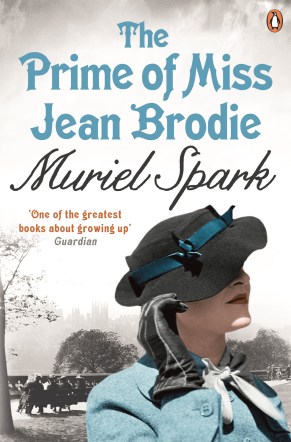
 Muriel Spark
Muriel Spark has been remembered lately: She was born in 1918 so this is her centenary. She ended her life in Tuscany, a grand old lady, having grown up in Edinburgh – and she has a gang of massive fans, the leader of whom is William Boyd. I’d never read her stuff, but I was affected by the outpouring, so I stopped at the library and picked up this – The Prime of Miss Jean Brodie – published in 1961 and supposedly a masterpiece.
And it was a masterpiece. It was the kind of book that lights up a room with an aura. It was only short, but every perfect sentence needed close attention. From the opening scene, where the schoolgirls are flirting with a bunch of boys at the school gates, a row of bicycles separating them, to the tragic unraveling of Jean Brodie, the story reads like it could only be one way – the exact way Spark wrote it – unfolding like a protein crystal or a developing blue whale embryo. It was an amazing creation.
The eponymous Jean Brodie is a very unusual schoolteacher at a rather wonderful Edinburgh girls’ school in the 1930s. The school is quite conventional, dedicated to giving young women a solid, well-rounded education in Arts and Sciences and Sports, but Miss Brodie is a maverick who takes a small group of chosen girls under her wing and tries to broaden their minds. This involves walking them round Edinburgh, serving them tea at her flat, and regaling them with stories of her love affairs and European travels. She also earnestly discusses with them her conflict with the school itself – which she realizes is keen to oust her. The girls, 11 years old at the beginning, are thrilled to be taken into the adult world in this way and made party to such previously unimagined, adult disagreements. They form ‘The Brodie set’ and are loyal to Miss Brodie and snooty to everyone else.
As the novel points out, there were at this time in Edinburgh many women just like Miss Brodie – unmarried women who’d lost their sweethearts in the Great War and yet were confident, worldly, full of ideas. It’s just that most of them weren’t schoolteachers. Miss Brodie, as she herself repeatedly, proudly states, is in the prime of her life – and she will dedicate that prime, she says, entirely to her girls. Yet the way she subverts their education is troublesome, she’s often scornful, she’s suspicious and sometimes, at least to one of the girls, Mary, she’s unkind. By type she is a self-appointed prophet.
How all this is revealed is a matter of great art. One way is that the girls begin to see past Miss Brodie – they get older and begin to recognize her obsessions. Another is Spark’s projecting into the future, so that we learn how the girls discuss Miss Brodie years later, when, grown up, they reminisce about their schooldays. Lastly, as Miss Brodie’s fears of betrayal deepen, her actions become more extreme – to the point that she manoeuvers one girl into a love affair with the art master.
By this point we’ve come a long way. We no longer view Miss Brodie as just an inspirational teacher.
Suspiciousness is the chief characteristic of a prophet. That’s an axiom. One of my favorite books, as a boy, was a sports novel by Brian Glanville called The Olympian that covered this brilliantly. The story begins with this 19-year-old club runner named Ike Low on the running track at Gospel Oak in North London. As Low comes round the bend, this old man in a grey sweater is shouting at him, ‘Keep your head up! Use your arms!’ Low thinks, ‘Oh sod off, you daft old cunt!’ but later the man appears in the changing rooms. Now it’s different. The old man stands with blazing blue eyes, and starts talking at Low about what makes a great athlete and a million other things. There’s something compelling about his crazy patter and Low realizes – it doesn’t need to be said – that the old man is going to train him.
Now, the old man, Sam Dee, is a maverick athletic coach with strong philosophical ideas about how to train (on Hampstead Heath), what to eat (no meat) and how to prepare for races (learn to go through the pain barrier). The trouble is, the athletics establishment hates Dee – they’re always trying to banish him – and so he demands total loyalty from his runners, and of course at some point, perhaps when they lose form, those same runners are going to question his methods and Dee will feel betrayed. This is exactly what happens after Ike becomes the world’s greatest miler (long before Coe and Steve Ovett and Cram did in real life). The novel then intensely examines the coach-athlete relationship.
I once worked for an Argentinean psychiatrist named Freddie G who was another prophet in the same mold. Freddie had a small hospital for adolescents that he ran on the lines of a therapeutic community. He was a maverick genius, adored by his flock of patients and acolytes, with a huge capacity to surprise people and create suspense and get through to teenagers. However he also did nutty things, like chain smoking cigarettes in front of the kids, and he wouldn’t bow to the authorities when they told him to modernize the unit. In the end they just wanted to close it down – close him down – and this must have fed into his suspiciousness. At my first community meeting (a daily ritual in the hospital) I made the grave error of taking notes. Freddie’s eyes fell on me, a silence descended, and then, in heavily accentuated words, came the Argentinian’s verdict: “I feel as if we’re under… police surveillance! Anything I say may be taken down and used in evidence against me!” Well, I felt like a bastard, like a collaborator after the liberation, like the subject of a public denunciation. And I thought: “You could have just fucking asked me to stop making notes!”
So who betrays Miss Jean Brodie? It’s one of her own girls, Sandy – the last one she suspects – the one who in later life becomes a nun in a convent, who at age 18 sleeps with the art master, and who at 17 has had enough of “that tiresome woman” and supplies the headmistress with the means to crucify her. Poor old Jean Brodie! She is forced to retire in 1939 to spend her last few years working out the betrayal. As to the reader’s feelings, they’re complex, because as the girls will all remember, later in their lives, Miss Brodie has been their mentor and their hero and their inspiration.


Really enjoyed reading a review of a book I have never read and will now look for. Thank you! Keep your arms pumping!
LikeLike
And my head up! Thanks Jonny. Let me know how you like the book. I thought it was terrific. Please keep the comments flowing… they’re so encouraging. Cheers
LikeLike
Enjoyed that Mark. Haven’t read the book but I feel sure you are spot on in describing the multi-faceted and interesting character that is Miss Brodie. Inspiration and Damnation all rolled into one.
Also liked the parallel you drew with the running coach.
I remember you raving about that book when we were in our teens.
Also see some parallels with how you described to me your own work with teens – as the inspirational maverick that is willing to risk being shot down for doing things a bit different…but aware of succumbing to the potential pitfalls this may entail.
Love and Peace.
Keep it up!
LikeLike
Thanks Slash. It’s so cool you’re reading these things. You’ve boosted my readership quite significantly. You remember Mr Alistair MacIntosh, of course? He was our Miss Jean Brodie. “Mackie” was such a great, hilarious and inspirational English teacher. He subverted that stuffy school we attended. And unlike Miss Brodie he wasn’t needy or twisted.
English teachers are a special breed – if they have the ability, they can really change kids’ lives.
LikeLike
The Dice Man!
Last line:
“Ah”, he said, “another option”.
Seem to remember you had a famous poet as your primary school English teacher prior to Mackie.
Hence your famous poetry line:
“And lick the orange from the rainbow!”
LikeLike
Hey Sasha,
Yes, I did have a primary school teacher who taught me poetry.
That was Sandy Brownjohn, who at the time (1975/6) was about 40 years old. She was a poet who also played the guitar, had long, straight black-and-silver hair, and a packet of cigarettes in the front of her denim jacket.
She was married to the poet Alan Brownjohn and knew other poets such as Kit Wright whom occasionally she’d bring into the school to meet us.
Sandy was really an educationalist and had big ideas about how to teach poetry (free form, no rhymes, lots of word games) and the importance of poetry and creativity.
She brought out poetry in a lot of different kids, year after year, and became quite famous in the worlds of poetry and education. There was one girl in my class, Sarah Simpson, a quiet little thing, who was head and shoulders above the rest of us. She wrote a poem about catkins (the fruit of the willow tree) that included a line (“And people see nature through a rosy haze of dizziness”) that just blew us all away. It’s still brilliant. Not just commenting on nature, but commenting on how people comment on nature!
Sandy had another side though – one that was not so nice. She certainly had her favourites (I was one of them) but she was mean to some of the others (such as my brother John). And she was violent. I can recall her dragging one mischief-maker across the classroom and physically booting him out.
Yeah I know, it was the 1970s, but still…
Overall I think she probably was the prophet type – another Miss Jean Brodie. She was a revolutionary. You were either one of her girls or you weren’t. And if you were, I’m sure she expected loyalty. I bet she was quite suspicious too – prophets always are.
Mackie on the other hand was not a prophet at all and that’s why I remember him so fondly. He was also around 40 when he was teaching us. Do you remember the long scarf he wore, like Doctor Who? He seemed to be a guy who loved literature but didn’t want to try too hard. There was one time (this is a story I’ve often told Millie and Alice) when he sent David Rubin out the classroom but then was laughing so much (despite himself, at a wisecrack David made*) that he had to hide his face.
Millie and Alice never get enough of that story.
Anyhow the point is, there are different ways to send a person out the classroom!
* David pretended to be crestfallen as he trooped out the room and said ‘Not playing!’ to anyone who was listening.
LikeLike