Katie Daynes
The Vietnam War is written by Katie Daynes – with designs by Karen Tomlins, 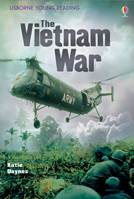 illustrations by Emmanuel Cerisier, photo research by Ruth King and history consultancy from Professor O.A. Westhad. It’s a group effort. A successful one!
In this regard, it stands in contrast to the United States’ collective failure in Vietnam.
It’s an Usborne book, so it’s aimed at kids and teenagers – but nowhere on the cover does it actually say that. My copy was supposed to be donated to Alice’s school library, but then I held it: ‘Guess what? I’ll keep you!’ It is in fact a beautiful book: small, hard-backed, durable, 64 pages in length, nicely written and packed with artfully-arranged photos, maps, and cartoon strips.
It’s an overview of a subject – Nam – that one ought to know already, given that the war was (i) so recent and (ii) so important to the way we see ourselves. And then one finds one doesn’t! One doesn’t even know the basics. For example, I didn’t know, or scarcely remembered, that the Vietnamese had already fought and won an anti-colonial war against the French from 1945 to 1954 – or that the Japanese previously had overrun those same French during WW2.
In praise of overviews! Those marvelous things! Why always the rush to zoom in? When I went to medical school, for example, the branches of the vagus nerve, or the relations of the carotid artery, were all recounted in a litany of excruciating detail. Boy, did I hate it! The wider issues – how to be healthy, say, or why humans stood up on two legs – were rarely meant for us. I ended up in psychiatry, the last refuge of the fuzzy-minded type of doctor.
So yes, amigo, by all means enjoy a 700-page volume on the Vietnam War, especially if it’s set in sparkling prose by a fine historian, but before lighting out you might start with the Usborne roadmap.
To recap, Vietnam was a French colony from the mid-19thcentury – and by the 1920s and 1930s was throbbing with resentment. The future leaders Ho Chi Mihn and Vo Nguyen Giap were in exile in China, exploring the ideas of the Indochina Communist Party (ICP). In the hubbub of WW2, during the Japanese occupation, they snuck back into the country to set up an ICP headquarters and the League for the Independence of Vietnam (Viet Minh). This was a military group that fought the Japanese with weapons from China and America.
After WW2 the Viet Minh fought the French, initially lost, and eventually prevailed, and in 1954 a peace conference in Switzerland led to the temporary splitting of the country into North and South Vietnam. This is where things get tricky. Not all the Vietnamese were gung-ho for communism. The North, under Ho Chi Minh, did go that way – but the South fell under the leadership of a certain Ngo Dihn Diem who was fervently anti-communist. The Americans supported him. Diem began arresting and killing suspected communists while the communists, under the direction of Ho Chi Minh in North Vietnam, responded by assassinating Diem’s officials.
So it was a state of civil war in South Vietnam. In 1961 President Kennedy sent 400 Special Forces troops to act as advisors to Diem’s army. US warships were also operating in the area. And from 1962 US airplanes were spraying the jungle with Agent Orange.
In 1963 Kennedy went on television to criticize Diem’s leadership of South Vietnam. He turned on his ally! Diem was then overthrown and executed by his own army. Kennedy was assassinated 3 weeks later. And if he hadn’t have been? Well that is a matter of counterfactuals.
My parents, Ted and Gill, immigrated to the United States in 1964, entering the country in early summer by the port of Hawaii. Aged 24 and 25, recently married, they were heading to New York City. In Honolulu they were issued with Form I-151 cards (already known colloquially as green cards). From Hawaii they flew to California, where they purchased a car and drove east.
The US war in Vietnam – little did they know – was about to get serious.
Ted had a job waiting at the Albert Einstein Hospital in the Bronx. He was starting on a training program for obstetricians – a program he would come to passionately hate. The problem was a crazy work schedule (one-in-two nights on call) and frenzied competition among the trainees. Gill, on the other hand, was pregnant, so she concentrated on settling. She liked being in America. It wasn’t South Africa! They lived north of the city in a block of modern flats in New Rochelle.
In August, as Ted took post, the North Vietnamese reportedly fired at US war ships in the Gulf of Tonkin. The new president, Lyndon B. Johnson, was given powers to fight back. But he hesitated. He cautioned his people (and himself presumably) against recklessness. In November he was reelected president, but it took several more attacks on American troops before he committed to fighting. It was the bombardment of a US airbase in February 1965 that finally made up his mind.

Around this time, Ted got summonsed for a US army medical. He was told to report to the military induction center at 39 Whitehall Street. This was located at the southern tip of Manhattan – from where one can look to Ellis Island and the Statue of Liberty.
Ted reported for the medical – and it’s a day he still often recalls. The other young men were scrawny and unsure of themselves with a poor grasp of English. Ted, who was skinny as a rake, ended up performing like a super-athlete. He won the 100 yards race!
During his medical, Ted mentioned to the army physician that he’d previously had a severe tropical fever, possibly malaria, back in South Africa. ‘Excellent!’ replied the physician, ‘We need men with immunity!’
The physician was pleased to gossip with a fellow doctor. Ted liked him. And he told Ted two important things. Firstly, Vietnam was going to get very big. Secondly, new immigrants were going to be drafted early.
Back at the hospital, there was plenty of talk about the nascent war. The young obstetricians went through the options. One alternative to being drafted was to volunteer under what they called the Berry Plan. You went to the army and offered to interrupt your residency – and as a result you might get a better deal. You could be a doctor on one of the bases in Germany or Texas.
‘But I’d never have gone,’ says Ted laconically. We’re sitting in the Coffee Cup in Hampstead, 54 years after his US Army medical. I try to imagine Ted skipping the country. It might have been difficult. When Uncle Sam wants you! I imagine Ted as a young doctor in Vietnam. He was always good in emergencies. I say, ‘Ted, you might have done well in Nam!’ I picture him as Alan Alda in MASH. Come to think of it, Alan Alda would be the perfect actor to play my dad in a movie. They look similar. They’re both doctors. They’re both jokers. Yes, that’s it!
But it wasn’t Vietnam that ended my parents’ time in America – it was the Obstetrics program. After a year they cut their losses. They went back to South Africa, had two more children, Nicki and John, and then emigrated again – this time to Britain that they both liked.
America refused to cut its losses. By the end of 1967 there were half a million US troops in Vietnam. In 1968 the Vietcong (a general term for Vietnamese communists) launched the Tet offensive to mark the Vietnamese New Year. Americans watched on TV as their embassy in Saigon was stormed and briefly overrun. Talks began in Paris and stretched over several years. But the war continued.
In 1972 Nixon ordered a massive bombing campaign on Hanoi. A peace agreement was signed in January 1973. But that still wasn’t the end. In March 1975 the North Vietnamese launched an offensive to take over the whole country. They soon succeeded. This is the bit of Vietnam I remember from my own TV life: those famous shots of US administrators and their friends waiting to be evacuated.
Gill and Ted’s stint in America was one of the founding stories of our family. Ted always professed to hate everything about America. Gill once told me that she’d gladly have stayed. But some things they both loved. When Sesame Street first aired in Britain it was a big deal in our family. Sesame Street had really blown them away in America. And when the early Woody Allen movies came through – “Take the Money and Run” and “Bananas” and “Play it Again, Sam” and “Everything You Always Wanted To Know About Sex” and “Sleeper” and “Love and Death” and “The Front” – we seemed to be represented. I mean, a lot of Jewish people might have felt a bit like that, but I can remember Gill and Ted really laughing their heads off.
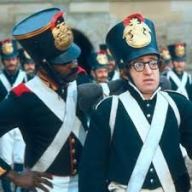
As for overviews, let Woody Allen have the last word. In Love and Death, Boris Grushenko (Woody Allen) gets drafted into the Russian Army to fight the French invasion. The Russian army is a parody of the US army. (“Hey you! You da worst soldier I ever seen!”) Boris becomes a war hero. Later, his impossible wife Sonja (Diane Keaton) sets him the task of assassinating Napoleon. ‘Don’t worry,’ he tells her, when she checks on his progress, ‘I’ve got all the details worked out. Now… if I could just come up with the basic plan, I’d really be onto something.’

 Book Reviews by Nathan Bronx
I’m very much in favour of learning from children’s literature, as it forces the writer to be clear and succinct, though with the Vietnam war I’d best start with the pre-school edition, such is my ignorance! Fascinating to hear of your family history Mark. I wonder whether under different conditions you might have gone on to be an American? Would have been Britain’s loss
LikeLike
Thanks Adam. It’s really cool to get your comments. I think you could handle the Usborne at a push!
LikeLike